

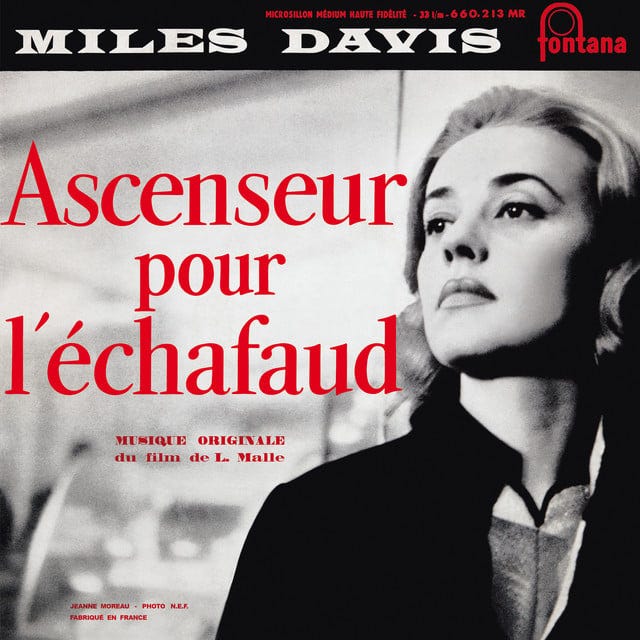
I get into very specific moods sometimes. About five years ago, I watched Louis Malle’s the 1958 film Elevator to the Gallows (Ascenseur pour l’échafaud) on a rainy night, and couldn’t stop thinking about the Miles Davis score for it. I’d actually heard the music before I’d seen the film, and like Richard Brody pointed out for The New Yorker in 2016, “It’s better than the film itself, by far.” I like the movie, but it’s one of those cases where if you omit something then it doesn’t quite hit. The work Davis did improvising with a few French musicians after he watched a cut of the film is up there as some of his best—which is saying a lot considering we’re talking about Miles Davis—and given the time of the year, I found myself wanting to only listen to stuff like it. I’d been familiar with the German group Bohren & Der Club Of Gore, so I started with them. They specialize in really moody, atmospheric sounds that, of course, somebody smartly summed up as “doom jazz.” There was plenty I could connect back to their music to get the same feeling, mostly soundtrack work by masters Angelo Badalamenti, Elmer Bernstein, and some of John Lurie’s work for Jim Jarmusch’s films, as well as his band the Lounge Lizards also fit the bill. Another of my favorites, Music for Egon Schiele by Rachel’s, did as well.
Despite my aversion to labeling everything, I searched out more stuff like it, ending up on an especially funny Discogs message board thread for “noir jazz” that descends into some choice record nerd name-calling. I started compiling the stuff I liked. The playlist I put together started becoming an unwieldily mess that started branching out into jazz vocalists like Billie Holiday or trip hop tracks by Portishead and Massive Attack. I have this tendency to start putting together playlists with the best of intentions, curating them the same way I used to make mixtapes, keeping a specific time limit in mind. Though, I’ve found with the nearly-limitless number of songs available on streaming platforms, I just tend to keep adding to some. A playlist that was supposed to be maybe 20 or 30 songs ends up with 500 tracks on it; two that I had made for drives that were under six hours now each have over an entire day’s-worth of music on them. It doesn’t usually bother me, and I just pretend that having so much music means I can just pretend I did some programming for an imaginary radio station, but it felt like the noir jazz (or whatever you want to call it) one I’d started creating needed to be on the shorter side to have an impact. I stopped adding to it for about two years until recently when I heard Andrew W.K.’s latest album, Temptation to Exist.

I won’t do that thing where I say something like, “yes, that Andrew W.K.” since “Party Hard” dropped 25 years ago and became a hit during the last great rock ‘n roll wave. That was an odd time where you had all these bands that were paying different kinds of rock, but somehow nearly everything was getting lumped under either the “garage rock” or “post punk” labels, like we were supposed to believed that the Vines—who I recall sounded like a pepped-up Silverchair—were equals of the White Stripes, or She Wants Revenge was going to be the 21st century’s answer to Joy Division. Andrew W.K. did feel like an anomaly, though, and although everybody I knew could admit the song was an undeniably ear worm, it also felt like possibly the guy was playing some sort of trick on the world. Not long after, a friend told me W.K. had come out of the Michigan noise scene that I was familiar with since a lot of the artists connected to it played around Chicago when I lived there in the late-1990s and early-2000s. I even remembered I’d seen his first EP for Bulb Records mentioned somewhere since I generally liked whatever that label put out. I kept tabs on what W.K. did over the years after “Party Hard” came out, always curious to see how what a guy with a background in classical piano and experimental music would do next.
One thing I eventually picked up was that while it was easy to initially dismiss what the guy was doing as pure schtick, W.K. (whose real name is Andrew Fetterly Wilkes-Krier ) is absolutely serious about what he does. His 2009 solo piano album, 55 Cadillac, was labeled by some as new age music, but given the title, his connection to the car-friendly Midwest, and his claims that releasing the album he wanted to make on indie label was his way of finding freedom, made me think about Bruce Springsteen noodling around trying to come up with the songs for Born to Run. I found myself creating little stories to the songs on 55 Cadillac, just little sketches that maybe made their way into larger things I worked on, but it’s nice to find an album that can inspire you to think a little about your own stuff.
Andrew W.K. did two more rock records after 55 Cadillac, then came Temptation to Exist. Like 55 Cadillac, it feels totally out of nowhere for a guy known for anthems about living life to the fullest. Where his piano album was sparse, though, Temptation to Exist is full and moody as hell. It is exactly what I’ve been looking for in hopes of finding another great album I could file under jazz noir or whatever the hell you want to call it. He owes a debt to Badalamenti’s Twin Peaks stuff, but there’s something that keeps reminding me of the 2021 masterpiece collaboration between Floating Points, London Symphony Orchestra, and Pharoah Sanders, Promises. The songs are mostly moody, but then he’ll do things like the ninth track, “For Steven,” which is more along the lines of Steve Reich Different Trains minimalism, almost like Andrew W.K. is challenging you to stay engaged for the entire album, or to turn it off. I love that.
I had to go ahead and revisit the jazz noir playlist I swore I’d stop adding to after I listened to Temptation to Exist a few times. I added every track from it, putting songs in places where I felt like they synced up with the ones I’d previously put on there. I don’t usually make playlists so I can listen to them straight through; instead, I tend to build them so I can hit the random button and not put much thought into it. I’m building a little narrative with the songs that I didn’t know I wanted to create until I heard Temptation to Exist. But even better is the fact that Andrew W.K. has found new ways to capture a listener’s attention for this long. He’s remained an anomaly, but he’s also shown how an artist can keep finding new avenues to explore regardless of what anybody might think. And by being willing to do that even this far into his career, Andrew W.K. ended up putting out one of the best albums of 2026.